Wednesday, March 29, 2017

Practicing Awareness of Microaggression


 I wish I had read the blog post assignment before doing the Diversity Profile as I described perhaps the most eye-opening scenario of microaggression from my own standpoint.  
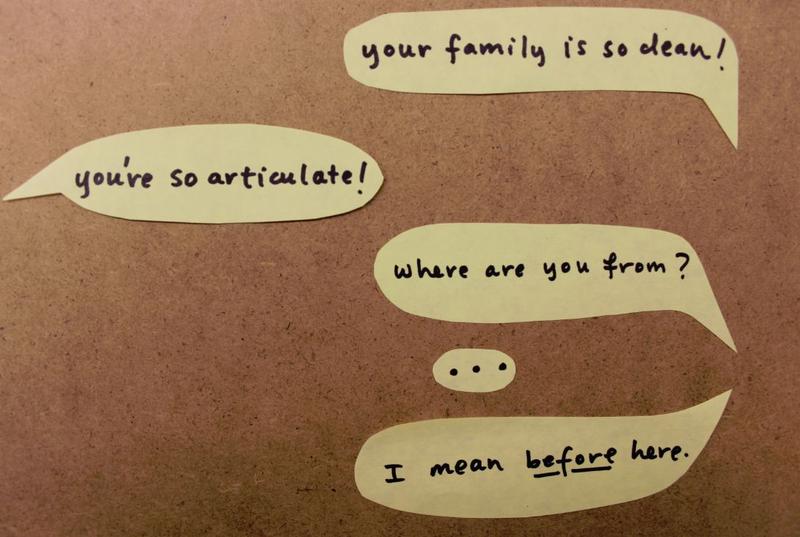
               After studying microaggressions this week, I now am in constant fear that I may have been a giver of microaggression without realizing it. I am an extremely sarcastic person that prefers to crack jokes with someone than hold a simple conversation. While I have had friends of every race, religion, spectrum of the gender scale, and so on, I fear that something I might have said could have been interpreted as microaggression. I never have meant any harm to anyone, both with my actions and with my words, but I could understand how microaggression could be identified from an outsider listening in to a conversation as well. For example, I have two extremely close friends who are both homosexual. We have been best friends throughout college and into our adult lives and would never cause any intentional harm to one another unless we are fighting over who gets the last pizza slice on our Sunday movie nights. However, after reading about microaggression this week, I am better understanding a situation I experienced when I was first engaged to my husband. I had met both my friends at a restaurant and as I have never had female friends, I asked both to be my brides men so that they may stand by me on my special day. I recall the waitresses face as she had come up after my speech and the joyful acceptance from both. I remember she looked insulted and horrified at the situation, but I thought it could be a range of things causing that emotion (a rough personal day, a situation with another table, perhaps even homophobia), but looking back now, I believe that she might have thought I was using microaggression as I asked two homosexual men to stand in a place usually reserved for female friends, perhaps she thought just because they are gay. As these two men are my closest friends in the world, it never held any source of doubt or indecency to ask them to stand by me, yet I could understand where others might perceive microaggression as well. Just as we viewed the scenarios in the discussion, you never know truly what the relationships are like with those individuals as well. What might be viewed as microaggression, could be interpreted differently by one another. That is why it is so important to understand what microaggression is and to perhaps even have a conversation about it with your friends to prevent a scenario like the ones given.

Saturday, March 25, 2017

Perspectives on Diversity and Culture

Image result for diversity
The beauty of culture is the diversity it brings to the world. No individual is the same when it comes to every aspect of culture. People differ in their thinking styles, their language, perspectives, experiences, and so on. It is with this in mind, that I asked three very close friends to me to share their experience with culture and diversity.

My good friend is a homosexual male who has spent his whole life knowing what his sexual orientation is and came out at a very early age to his family. As his parents were both extremely welcome, he has not had to endure the stigma often associated with coming out to loved ones. He admits that the worst part of admitting his sexual orientation came from when his close friends in college found out. As they were both conservative Christians, they immediately stopped talking to him and refused to acknowledge this very important part of his life. In fact, one of his friends still refuses to speak with him to this day, while the other decided to ask questions and to try and understand his way of life. While it was still hard for him to speak with this friend after they initially rejected him as he truly was, he understood that their culture and way of life made it difficult for them to understand his sexual orientation, but the fact that they were willing to learn about his culture was comforting.

Another friend married into a Jewish family and as she was born and raised in a Catholic household, she lied to her family for the first two years of her marriage that she still attended church every Sunday, when in reality, she attended temple every Saturday. It took her two years before she finally told her mother who opened up to her daughter that she herself was born and raised a Baptist. She had also lied to her family when she got married to a Catholic man, stating that she was still a practicing Baptism. My friend felt relief after telling her mother, yet was taken aback that her mother had hid this from her knowing her situation.

My final interview was actually friends who are identical twins. While they both lived the in the same household until college, practicing the same traditions and customs of their Indian family, they both have renounced certain customs to adapt to the dominant culture of where they live in Los Angeles, California. They said they both chose to go against their cultural customs and expectations in order to pursue careers as artists. They have not talked to their family after their move which has been about five years. They do not regret their decision as it has led them into a different world in which they enjoy, yet the fact that their family broke ties with them based on their decision to adapt to the dominant culture is heartbreaking.

When I asked each of my friends their definition of culture and diversity, they each expressed their idea of culture as their childhood. The customs and traditions that they shared growing up exemplify their definition of culture as being family and the way they interact with one another. While the first friend expressed how open-minded his family was and the way in which culture was acknowledged and celebrated was altered when he arrived at college and realized that his friends grew up completely different as their families were so conservative. My second friend believed culture was how she also grew up, with the knowledge that Catholicism was key to everything one did. She defined diversity as the chance to mix things up, elaborating that diversity is what gives spice to life; it changes the world around us and makes us know that we are unique. The twins both exclaimed culture represented a world in which they could not express themselves, yet they also acknowledged how the dominant culture in which they live accepts them for who they are and what they want to do.

It shows that even families differ in their cultures and practices and perhaps the most important aspect is how people change. While culture and diversity seem so set in tradition and certain ways of life, humans are beings of choices which means that change is always possible.

Thursday, March 16, 2017

My Family Culture

A major catastrophe has almost completely devastated the infrastructure of your country. The emergency government has decided that the surviving citizens will be best served if they are evacuated to other countries willing to take refugees. You and your immediate family are among the survivors of this catastrophic event. However, you have absolutely no input into the final destination or in any other evacuation details. You are told that your host country’s culture is completely different from your own, and that you might have to stay there permanently. You are further told that, in addition to one change of clothes, you can only take 3 small items with you. You decide to take three items that you hold dear and that represent your family culture.

       I saw down to do this assignment about four days ago, but after reading the assignment, I knew I needed more time to think on it.  As I would go about my daily business, I would end up staring at things around my house, wondering if it would be an item I would grab in a situation like this. After a couple days of this, and my husband continuously asking if I was alright, I came up with three items that I believe represent me and my family culture. (For my own personal assumptions and to give me a peace of mind, I am going to assume my two dogs would be coming with me as I would have made each of them an item otherwise as they are basically my husband and I's children).

1. As a daughter to teenage parents, I quickly learned the value of a penny and the necessity of putting money into the needs and earning money for the wants. I believe it is this childhood that lead me to such trouble picking out materialistic items that represent who I, and my family culture, are. However, I do believe that I would bring along my old Teddy Bear I received when I turned 3. It was the only gift I received, yet she has traveled all over the country with me and has earned a spot in my guest bedroom's bed. Not only was she my comfort during long moves from base housing to base housing, but there is also part of her dress that was torn when my childhood dog decided to chew on a button. It is also the same tear the my angel of a grandmother sewed back for me. That bear represents a lot more than just the comfort of a stuffed animal, it represents history and was given to me at a time when my family had nothing; it seems fitting that this bear would be with me as our family was once again reduced to nothing in this scenario.

2. While I would like to say my second item would be a photo album, I could almost guarantee another member of my immediate family would grab the worn down one sitting at my parents house, meaning that I would still have access to old memories and the evolution of my small family. However, I would bring along a single picture that is currently on my fridge of myself and my brother and sister along with previously mentioned family dog. It reflects a time, and an age, in which I still remember my siblings. My brother with a bowl haircut and just a hint of a lisp, always making sure my sister and I were taken care of. My sister with her gorgeous blonde locks, so different from the red and brown siblings sitting near her, with a passion for pushing past boundaries to achieve her goal. And even myself, bangs included, with a comforting hand around my two younger siblings, as I grew up as a second mom since both my parents worked and attended school during the formative years. My siblings come before anything else in this world and this picture would give me the strength to keep going. 

3. For my final item, I believe I would pick a shirt that I received at the camp I met my husband at. Even though my family has lived all over the United States, each one of us has always been reserved in our ways, preferring the company of those closest to us, never reaching out past our comfort zones. I was no different, especially during my college years, I had a select group of friends and otherwise spent my time going to class, to the gym, and the library respectively. For whatever reason, my Sophomore year of college saw me in a Recreation and Leisure class that I was encouraged to drop by my advisor as my Recreation and Leisure major had been dropped at my university. Yet I still chose to stay in the class that started way after my other classes ended and was on the other side of the campus. It was through this class that I learned about a camp called Camp Twin Lakes that services a range of differently-abled children and adults. Through the extensive list of different camps that attend during the summer, Camp Oo-U-La stuck out to me because of the unique name. I ended up applying for the camp that serviced children who were burn survivors to attend that summer with no previous experience nor affiliations with the camp. It was within the first few days of attending the camp that I found my passion for working with children and fell in love with a camper-turned-counselor burn survivor who made me laugh till I cried. Taking along one of the many shirts I have received from this camp through my following years of volunteering, would take me back to a time where I felt vulnerable, only to be received with a new passion and even a best friend/partner in crime. During this who scenario, this shirt would remind me that sometimes we all feel uncomfortable or vulnerable, yet the more we push past these feelings, something beautiful awaits us at the end. 

          After finding it increasingly hard to pick three items that represented me and my culture, it became even harder to choose just one item after listing out what each one meant to me. I believe the picture of myself and my siblings would take precedence. It is a picture that has traveled with me to different countries, different houses, through different life scenarios, and every time, it has given me strength. I believe in this refugee scenario, the best thing someone can have is strength and a reason to keep going. I find that true in everyday life as well. We must all have something to keep fighting for.

Friday, March 3, 2017

When I Think of Research...

 
Having taken a research course before, I was lucky enough to already have background knowledge in the methodology and vocabulary of the research world. However, as I am still new to the field of early childhood, this course was a complete learning experience for me. I was able to develop my own research simulation and dive into what it takes to design a research study. I was able to look at my initial topic from multiple angles and truly understand the process of research design so that I could produce the best possible conclusion for my simulation. The insights I have gained within this course far outweigh any type of information I could have learned within my own research and the chance to collaborate with my colleagues provided one of the biggest incentives to log onto the Walden website almost every day. 

I believe my idea about the nature of doing research changed as I realized just how important and essential it is to the field of early childhood, not only to the children and families the members serve, but to the field itself. Without research, it can be nearly impossible for policy and law makers to envoke change and for advocates to have a firm platform on which to make change. With research comes evidence and data that can be used to better the generations of children and aid their families and educators in the process. 

I learned all about the planning, designing, and conducting of research in early childhood. From the initial design process (do I want to collect qualitative or quantitative data? or would a mixed methods approach be better?), to the way to choose participants (random?), to even the ethical thoughts that must remain forefront in the researcher's brain throughout the entire process. The attention to detail and the plan to always stay a step ahead had to be learned through this course as we developed our own simulations that allowed us the chance to plan and change our study to provide the best possible outcomes.

I believe the biggest challenge that I encountered was the mere magnitude conducting research takes out of someone. Even just developing a simulation left me many times exhausted and self-doubting as I constantly questioned whether or not my attention to detail was enough to develop a successful research simulation. I can only imagine what actually conducting research must feel like, yet it makes me excited at the possibility of perhaps conducting my own study someday.